This blog post will be exploring how the impactful Women’s Aid campaign during the 2022 World Cup had a societal impact and made the audience stop, think and donate to charity.
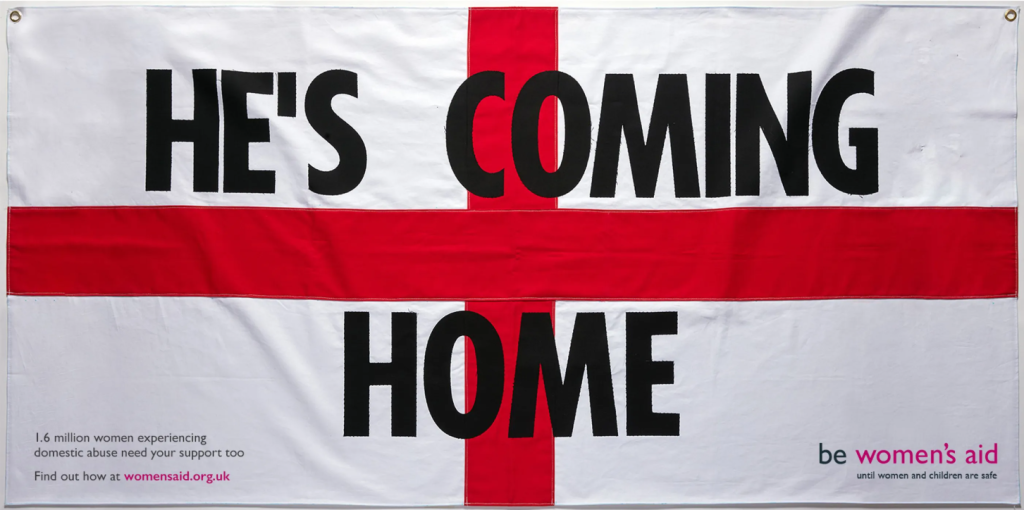
This design uses the St. George flag as a backdrop and a twist on the classic football chant/song ‘it’s coming home’ to communicate the message of domestic abuse against women. With shocking figures on the number of women that are abused and a video campaign that implies how this abuse increases during large football events, this simple design communicates a strong message, that the “women experiencing domestic abuse need your support too”.
As demonstrated in the video, during large football events the national flag of England is put up around the country to show support to the England team, it symbolizes pride and patriotism. In recent years the flags meaning has been skewed, with it being used as a cultural weapon that represents division of class, race, nationality and is commonly used by the far right as a connotation for their beliefs. This campaign draws from these ideas by using the flag as a visual language that demonstrates the negative impact that this pride can have on women’s safety. “The risk of domestic abuse rose by 26 percent when the English national team won or drew, and a 38 percent increase when the national team lost” (Kirby et al., 2013).
The use of language within this design is impactful, the design team changed just one word from the chant but completely changed the tone and meaning. The font chosen for the campaign is similar to that of a Sun or Daily Star newspaper headline, these newspapers are targeted towards the working class and might connect to the type of patriotic British man we associate these flags being flown by. The bold, black typeface is strong, serious and would be easily readable for drivers passing by a billboard.
The campaign went viral and reached people who may not have considered the negative impact that the World Cup, and other large football events have on domestic abuse. It created a conversation and had an impact on public perception, it had a combined reach of 222 million on social media (ELVIS London, 2023). Without social media, this campaign may have needed a larger budget to connect with the audience and that could have adversely impacted the reach. The campaign increased traffic to the Women’s Aid website by 78.3% with a 44% increase in visits to their donation page (Women’s Aid, 2024). Whilst being a serious and eerie campaign it increased the donations to Women’s Aid and hopefully will have positively impacted women who were experiencing abuse lives.
References
D&AD (2023) Women’s Aid – He’s coming home. https://www.dandad.org/work/d-ad-awards-archive/womens-aid-hes-coming-home [Accessed 17 Feb 2026].
ELVIS London (2023) Women’s Aid – He’s coming home – case study [Vimeo]. https://vimeo.com/854645498 [Accessed 2 Apr 2026].
Kirby, S., Francis, B. & O’Flaherty, R. (2013) Can the FIFA World Cup football (soccer) tournament be associated with an increase in domestic abuse? Journal of Research in Crime and Delinquency, 51(3), 259-276. https://doi.org/10.1177/0022427813494843
Women’s Aid (2023) He’s coming home [Video]. https://www.youtube.com/watch?v=8BTCSYFmXvU [Accessed 17 Feb 2026].
Women’s Aid (2024) Women’s Aid launches ‘No More Years of Hurt’ campaign highlighting the spike in domestic abuse during big football games. https://womensaid.org.uk/womens-aid-launches-no-more-years-of-hurt-campaign-highlighting-the-spike-in-domestic-abuse-during-big-football-games/ [Accessed 17 Feb 2026].