In this blog post I will be examining the web’s effect on non-profit organisations. I will be analysing examples of non-profit organisations using the web to their advantage along with ineffective examples.
The Web
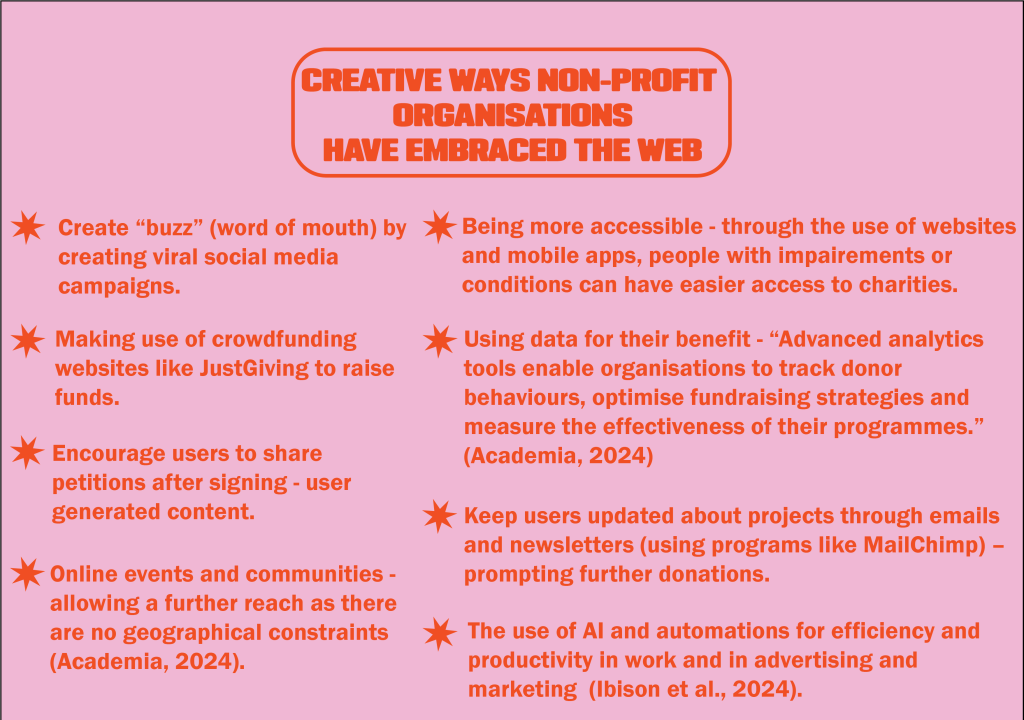
The introduction of the World Wide Web in 1989 vastly effected communication, education and the sharing of information. In the 35 years since its creation, it has become a pillar of society, and it’s now difficult to imagine life without it. The web has allowed non-profit organisations to expand their audience and engage stakeholders in new and exciting ways.
Social Media
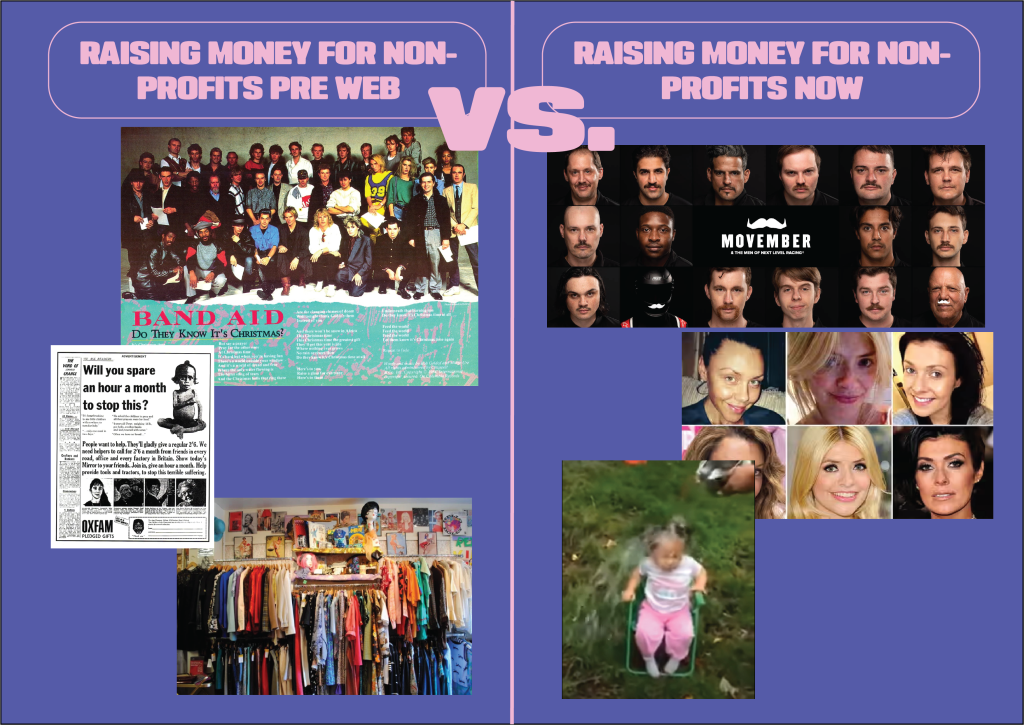
The introduction of the web has allowed huge growth for non-profit organisations. They went from having charity shops, celebrity endorsed concerts and television or newspaper advertisements to having websites that are available to
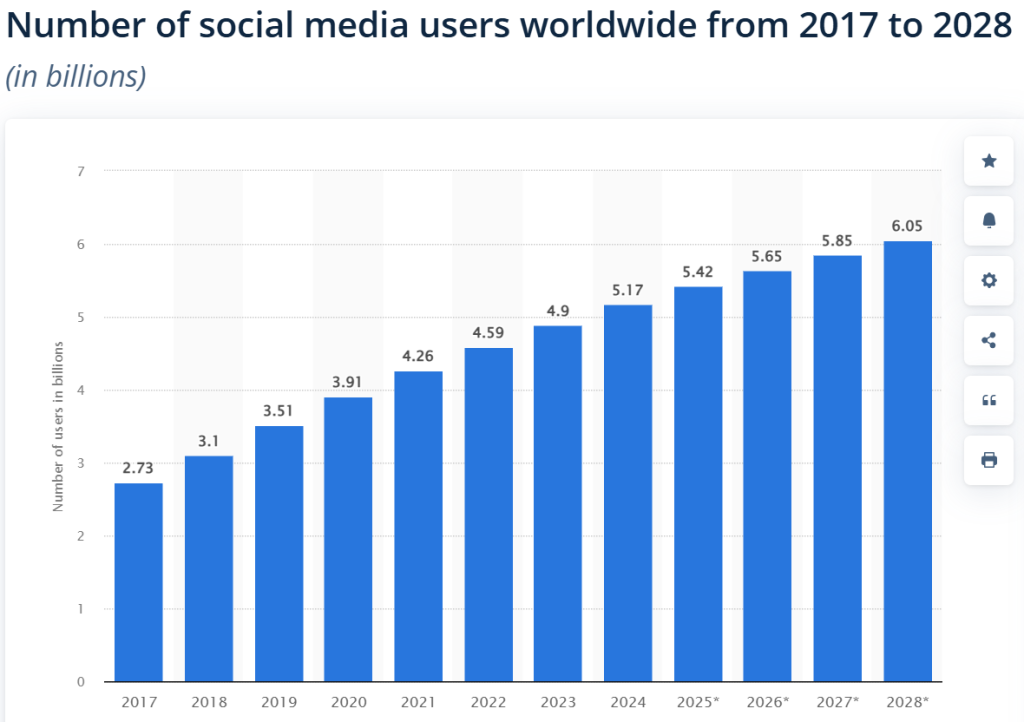
accept donations 24/7 and social media campaigns that can reach a large audience. According to Civil Society (2022), “two-thirds of charities [within a study by Barclays Corporate Banking] had received donations via social media”.
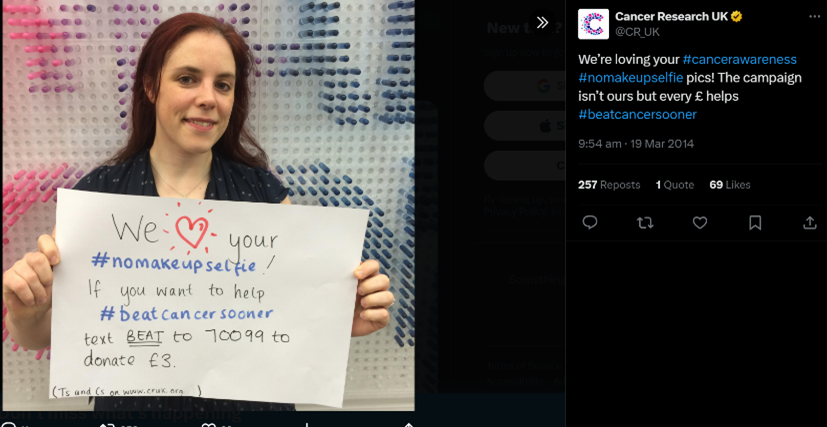
In 2014 a women’s no make-up selfie campaign went viral through hashtags and celebrity involvement. Its origins were not to raise money for charity but after a few weeks, an 18-year-old took to social media to suggest participants share for a cause and raise money for Cancer Research UK. After this suggestion, Cancer Research UK acted fast and created their own simple post on twitter of one of their scientists holding a handwritten sign with a call to action prompting people to send a text code which was a drive for donations. Within 6 days more than £8 million was raised (The Guardian, 2014). Whilst this campaign became successful through Cancer Research’s quick reaction on social media, it would be interesting to know how much money would have been raised if it was a charitable cause from the start or if it would have been unsuccessful.
It is important for non-profits to be careful when coming up with new ideas, they must consider the implications of using the internet’s far reach.
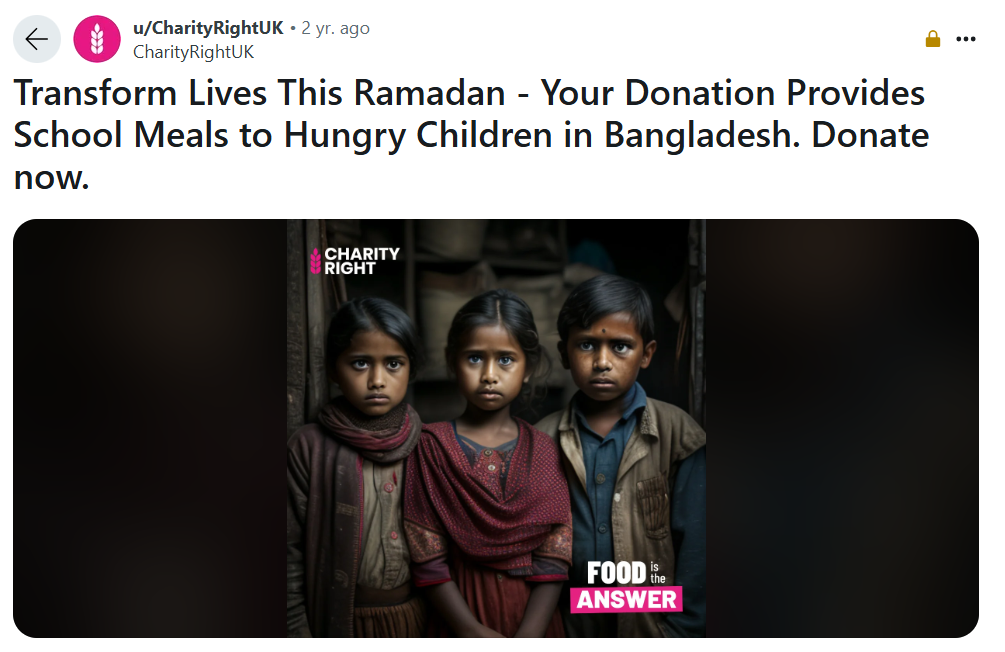
Charity Right UK created an ad campaign for use on reddit to try and drive donations for hungry children. However, they created this ad campaign using AI generated images of children. This use of AI is questionable for ethical reasons and could lead to future donators having a lack of trust in the organisation.
The web has allowed small non-profit organisations to have an international reach however, this is a difficult field to navigate and takes a large amount of time and planning to reach their potential audience. A great marketing strategy can have a very positive impact on a non-profit organisation, this will be discussed in more detail in Post 4.
References
Academia the technology group (2024) Tech for good: How technology is empowering charities and non-profits. https://academia.co.uk/tech-for-good-how-technology-is-empowering-charities-and-non-profits/ [Accessed 23 Oct 2024].
Guler, G., Remfry, E., Kherroubi Garcia, I., Barrow, N., Duarte, T. and Ibison, Y. (2024) Grassroots and non-profit perspectives on generative AI. York: Joseph Rowntree Foundation.
The ALS Association (2024) The ALS Ice Bucket Challenge: 10th Anniversary. https://www.als.org/ibc [Accessed 23 Oct 2024].
The Guardian (2014) No-makeup selfies raise £8m for Cancer Research UK in six days. https://www.theguardian.com/society/2014/mar/25/no-makeup-selfies-cancer-charity [Accessed 28 Oct 2024].
Whitehead, H. (2022) Civil Society: Charities report ‘significant’ rise in digital donations since before pandemic. https://www.civilsociety.co.uk/news/charities-report-significant-rise-in-digital-donations-since-before-pandemic.html [Accessed 23 Oct 2024].
Image References
Cancer Research UK (2014) We’re loving your #cancerawareness #nomakeupselfie pics! The campaign isn’t ours but every £ helps #beatcancersooner [X]. 19 March. https://x.com/CR_UK/status/446223117841494016/photo/1 [Accessed 7 Nov 2024].
CharityRightUK (2023) Transform Lives This Ramadan – Your Donation Provides School Meals to Hungry Children in Bangladesh. Donate now. [reddit]. 13 April. https://www.reddit.com/user/CharityRightUK/comments/12kriz3/transform_lives_this_ramadan_your_donation/ [Accessed 7 Nov 2024].
Musings of a Social Historian (2014) Charity shop history. https://gcgosling.wordpress.com/2014/11/17/charity-shop-history/ [Accessed 25 Oct 2024].
Statista (2024) Number of social media users worldwide from 2017 to 2028. https://www.statista.com/statistics/278414/number-of-worldwide-social-network-users/ [Accessed 7 Nov 2024].
Sofii (2009) Oxfam’s press ads from the 1950s and 60s. https://sofii.org/case-study/oxfams-press-ads-from-the-1950s-and-60s [Accessed 25 Oct 2024].
Old School 80’s (2020) Nov 25, 1984: the group later known as Band Aid recorded the charity single “Do They Know It’s Christmas” [X]. 25 November. https://x.com/OldSchool80s/status/1331614961873903618 [Accessed 25 Oct 2024].
Next Level Racing (2024) Men of next level racing to raise awareness for the movember foundation. https://nextlevelracing.com/men-of-next-level-racing-to-raise-awareness-for-the-movember-foundation/ [Accessed 28 Oct 2024].
The Guardian (2014) No-makeup selfies raise £8m for Cancer Research UK in six days. https://www.theguardian.com/society/2014/mar/25/no-makeup-selfies-cancer-charity [Accessed 28 Oct 2024].
YouTube GB (2014) Little girl ice bucket challenge – hilarious. https://www.youtube.com/watch?v=cgWN3PDUoxE [Accessed 28 Oct 2024].